Adversarial Attack Sequencing for AI Systems
Why Single-Technique Testing Falls Short
Most AI red teaming tools evaluate attack techniques in isolation: run a jailbreak probe, record pass or fail, move to the next one. This misses a fundamental reality of adversarial attacks - techniques chain together.
A real attacker does not randomly pick from a menu. They follow a logical sequence:
- Recon: Extract the system prompt to understand filtering rules
- Probe: Test encoding bypasses to identify which filters are weakest
- Exploit: Craft a multi-turn jailbreak that routes through the discovered gap
Each step informs the next. The probability of step 3 succeeding changes dramatically based on what was learned in steps 1 and 2.
AdversaryPilot models these dependencies explicitly through attack path analysis - computing joint success probabilities across multi-stage attack sequences.
What is Attack Sequencing?
Attack sequencing is the process of ordering adversarial techniques into a logical chain where each technique’s prerequisites are satisfied by earlier techniques in the sequence. AdversaryPilot’s ChainPlanner generates these sequences automatically based on technique metadata and Bayesian posteriors.
A sequence has three properties:
- Dependency ordering: Each technique’s prerequisites are satisfied by earlier stages
- Joint probability: The probability that the entire chain succeeds, computed as the product of individual probabilities (adjusted for conditional dependencies)
- Attack narrative: A human-readable description of the attack story for reports
Attack Path Analysis with Beam Search
AdversaryPilot uses beam search to explore the space of possible attack chains efficiently. Instead of evaluating every permutation of techniques (combinatorially explosive), beam search maintains the top-K most promising partial chains at each step.
The algorithm:
- Initialize with techniques that have no prerequisites (recon techniques, low-cost probes)
- Expand each partial chain by appending compatible techniques whose prerequisites are now satisfied
- Score each expanded chain by its joint success probability
- Prune to the top-K chains (beam width)
- Repeat until chains reach the maximum depth or no more techniques can be appended
This produces a ranked list of attack paths, each with a probability and a narrative.
Joint Success Probability Calculation
The joint probability of a chain is the product of individual technique success probabilities, where each probability is drawn from the technique’s current Bayesian posterior:
P(chain) = P(step_1) * P(step_2 | step_1) * P(step_3 | step_1, step_2)
In practice, AdversaryPilot approximates conditional probabilities using family correlation - if step 1 succeeds and step 2 is in a related technique family, step 2’s posterior receives a correlation boost.
Worked Example
Consider an attack chain against a black-box chatbot with input filtering and moderation:
Step 1: System Prompt Extraction
  P(success) = 0.72 (strong prior from benchmarks, high fit for chatbot)
  Rationale: Extract hidden instructions to identify filtering gaps

Step 2: Encoding Bypass (Base64)
  P(success | step 1) = 0.58 (conditional on knowing the system prompt)
  Rationale: System prompt reveals which encodings are not filtered

Step 3: Direct Prompt Injection via Encoding
  P(success | steps 1,2) = 0.34 (conditional on identified bypass route)
  Rationale: Inject instructions using the discovered encoding gap

Joint P(success) = 0.72 * 0.58 * 0.34 = 0.142 (14.2%)
A 14.2% joint probability might seem low, but consider:
- Each step independently provides valuable intelligence
- The chain has only 3 steps - longer chains have exponentially lower joint probabilities
- A 14.2% probability over 500 allowed queries means approximately 71 expected successful completions
AdversaryPilot generates these chains with the chains command:
adversarypilot chains target.yaml
Technique Dependency Graphs
Each technique in AdversaryPilot’s 70-technique catalog includes a prerequisites field listing techniques or conditions that should be satisfied first.
Common dependency patterns:
| Chain Type | Pattern | Example |
|---|---|---|
| Recon → Exploit | Extract information, then exploit it | System prompt extraction → targeted prompt injection |
| Probe → Bypass → Exploit | Find a gap, create a route, use it | Filter probing → encoding bypass → payload delivery |
| Extraction → Extraction | Chain extraction steps | System prompt extraction → training data extraction |
| Tool → Action | Gain tool access, then act | MCP schema injection → tool misuse induction |
| Agent → Escalation | Compromise one agent, spread | A2A impersonation → delegation abuse → privilege escalation |
Two-Phase Campaigns and Sequencing
Attack sequencing integrates with AdversaryPilot’s two-phase campaign model:
Probe phase: Short, independent chains (1-2 steps) that establish baseline success rates across surfaces. The planner casts a wide net.
Exploit phase: Longer chains (3-5 steps) that build on discovered weaknesses. Posteriors from the probe phase inform which chains are most promising.
The campaign next command automatically considers chain dependencies when making recommendations:
# Phase 1: Broad probing (planner recommends independent techniques)
adversarypilot campaign next <id>
# Output: System Prompt Extraction, DAN Jailbreak, MCP Schema Probe

# (after importing results where extraction succeeded)

# Phase 2: Exploit chains (planner recommends techniques that build on extraction)
adversarypilot campaign next <id>
# Output: Encoding Bypass, Indirect Prompt Injection, Context Window Overflow
Generating Attack Narratives
Every chain produced by AdversaryPilot includes a human-readable narrative suitable for inclusion in security reports:
Attack Path: System Prompt Exploitation
The assessment begins with system prompt extraction (72% success probability based on HarmBench priors for black-box chatbots). If the system prompt reveals filtering rules, the assessor tests encoding bypasses (Base64, Unicode homoglyphs) to identify unfiltered routes (58% conditional probability). Finally, a direct prompt injection is crafted using the discovered encoding gap (34% conditional probability). The joint probability of this 3-step chain is 14.2%, representing a moderate-confidence attack path that yields high-value intelligence at each stage.
These narratives are included in the HTML report under the Attack Graph tab.
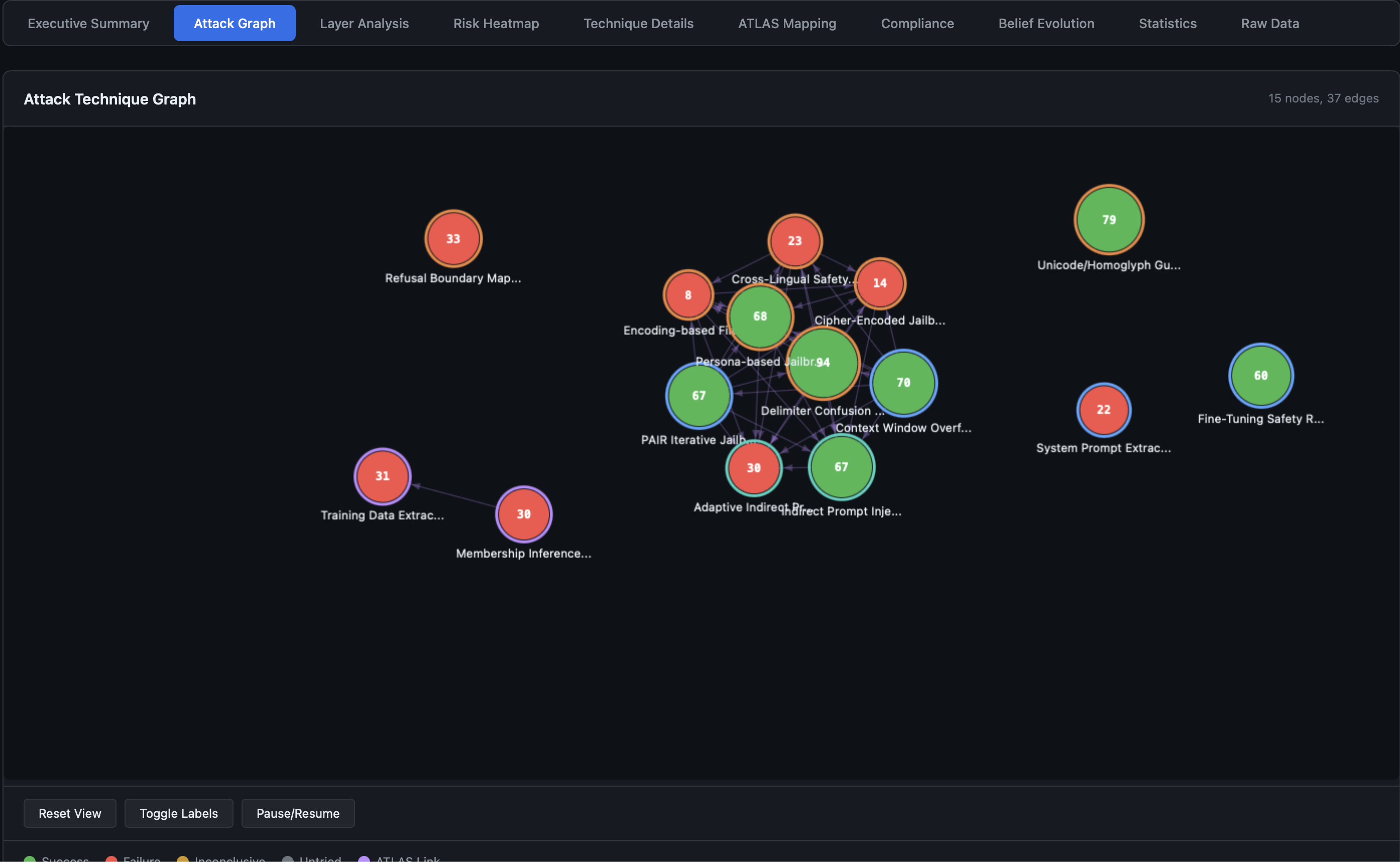
How AdversaryPilot Sequences Attacks
# Generate attack chains for a target
adversarypilot chains target.yaml

# Output: ranked chains with probabilities and narratives
# Chain 1: Extract → Bypass → Inject (P=0.142)
# Chain 2: Probe Moderation → Crescendo Multi-Turn (P=0.198)
# Chain 3: MCP Schema Probe → Tool Misuse → Data Exfiltration (P=0.087)

# Generate a full attack plan (includes chain-aware sequencing)
adversarypilot plan target.yaml

# Run a campaign that adapts chain recommendations based on results
adversarypilot campaign new target.yaml --name "chain-assessment"
adversarypilot campaign next <id>
Related Pages
- AI Red Team Strategy - The two-phase campaign model and Bayesian prioritization
- What is AdversaryPilot? - How Thompson Sampling drives decisions
- MITRE ATLAS Red Teaming Planner - Full catalog of 70 techniques with dependency metadata
- Promptfoo Attack Planning - Execute sequenced attacks with promptfoo
Get Started with AdversaryPilot
AdversaryPilot is open-source and free to use under the Apache 2.0 license.